

What Kyndred Makes
Part 2: Television

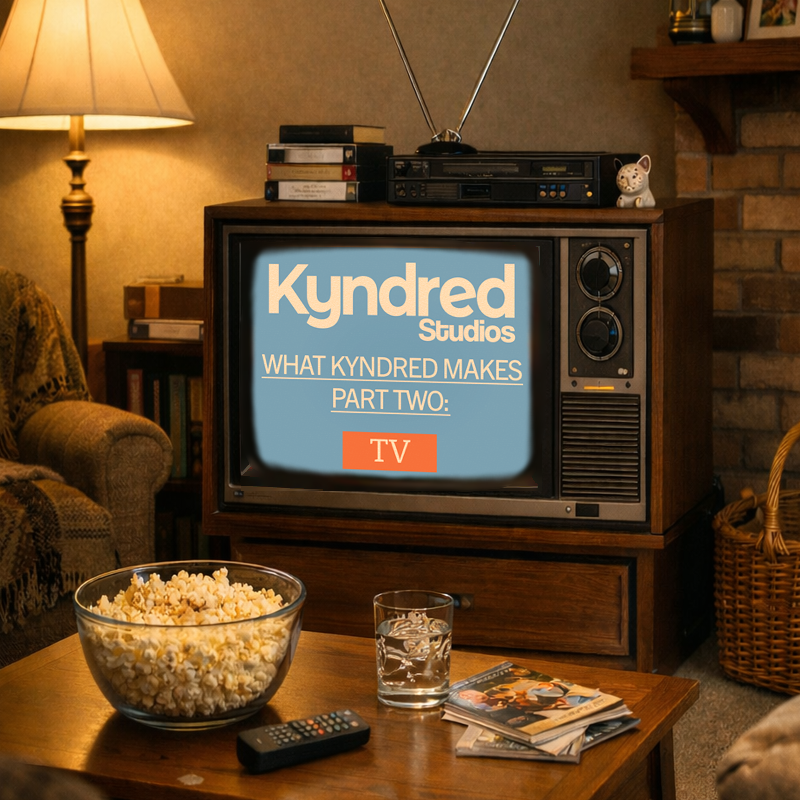
Alongside movies, I grew up with television, but it had a different impact.
Movies were events but television was the constant presence. A lighthouse at the end of the day. It was stable and secure. A constant, like Thursday nights with my parents watching Seinfeld because nightly TV as a family was still a thing. It was lots of network programming, and mostly comedies like Perfect Strangers (our family cat was named Twinkie, a nod to Mr. Twinkacetti), Family Matters (I probably drove my family nuts trying to master a voice impression of Urkel), and The Fresh Prince (a sitcom that had some poignant moments and maybe helped your parents understand your world a little better). TV kind of fell into the background during college as life got busier, but then came the first season of The Sopranos, which I actually watched on DVD because I was a broke 20 year old and couldn’t afford HBO. With that show, cable opened up something on television that hadn’t been done at that scale before. Longer arcs. Darker characters. Adult storytelling that trusted the audience. The Wire pushed it further. Six Feet Under took it somewhere more interior. Mad Men made it elegant. A generation of writers and audiences realized that television was no longer the “smaller” format.
I loved the medium before I worked in it, and after twenty years inside the business, much of it spent in formats that never fully aligned with my instincts, I only wanted more to help produce the kinds of shows I would be drawn to as a viewer. As my taste evolved, I found myself connecting most with television that felt cinematic without losing what makes TV special. Episodes that carried the craft and intentionality of movies, but with the added gift of longer character arcs and the time to let characters show you more of who they were.
When I look at the shows I keep coming back to, a few patterns show up. Character first. Mulder and Scully. Don and Peggy. Omar. Vic, Shane and Curtis. Fleabag. The Roys. Everyone in The Leftovers. The shows that stick are the ones where the people feel real enough that you connect to something inside yourself, whether they’re heroes or monsters.
Those characters live in ambitious genre pieces, too. The Expanse. Severance. Silo. Watchmen. Shōgun. The Last of Us. Stories that use science fiction, fantasy, or horror as a lens into human behavior rather than a costume to mask it. They show up in comedies that make you laugh but can make you a little uncomfortable, too. Barry. Succession (which can be a comedy depending on the episode - a ‘tramady’?). Shrinking. Party Down. Reservation Dogs. I’m Sorry. The Studio. Shows that trust the audience to keep up. They can really shine in limited series. Chernobyl. Mare of Easttown. The Night Of. The Queen’s Gambit. Station Eleven. A complete story in a tight frame. No second season because the story is done. That can be a gift to the audience, and a discipline most of the industry has forgotten.
And then there is The Bear, which sits in its own category for me because it hits me in a way not many other shows do. Not because of the restaurant world, though I hear it gets that right too, but because of the tenderness of it. The portrayal of family, both biological and chosen. The way it deals with the grief of losing someone you love to suicide.
I’ve written before about how I lost my best friend from college to suicide last year, and the most recent season aired at almost exactly the same time I was trying to process that loss. Watching Carmy carry Mikey’s spirit through every episode, and recognizing so much of his pain, grief, and trauma response, left me sobbing by the end of the season. It also left me feeling compassion for that character on a level I wasn’t prepared for. The Bear articulated something I was living through in real time. It gave me something to point to when I didn’t have the words to communicate what it was that I was feeling. It understood that loss like that does not resolve cleanly. You compartmentalize it, and it can make you behave in ways that are unpredictable, even to yourself. You try to work through it and show up for the people who are still here, and if you’re lucky, you figure out ways to let them into what you’re going through because if you don’t, you might just explode.
A show that can do that while also being funny, visually alive, warm, and structurally inventive is exactly the kind of work I want to help make possible. I think a lot of great television is still being made right now. The talent pipeline hasn’t dried up. The writing isn’t worse. The ambition is still there. What’s broken is the structure around it.
When Christopher Storer won his Emmy for The Bear, he used part of his speech to talk about the financial reality of being a working writer right now. The creator of one of the most celebrated shows on television was calling out the struggle. If he’s having that conversation, imagine what it looks like for the writers and crew that haven’t achieved that level of success. The people making the work are too often undercompensated relative to the value they create.
The industry is facing other issues as well. Shows that deserve a run are getting cancelled before they hit their apex. The Perry Mason reboot is the one that stings for me as a viewer. Two seasons of gorgeous, atmospheric, character-rich noir, something we haven’t had enough of lately, cancelled right as it was finding its footing. That story of cancellation is not unusual anymore. It is routine.
Seasons have compressed to ten, and in some cases, just eight episodes, and that gets framed like a creative evolution when a lot of the time it is really an economic one. Smaller rooms. Less time for younger writers to develop. Fewer episodes for a show to find its voice, deepen its bench, and let supporting characters become essential. I am not arguing that everything should go back to twenty-two. In a lot of cases, that was too many and you could feel it. But I also do not think eight or ten should be the automatic default. Some shows want six. Some want ten. Some want fifteen. The shape should come from the story, not from a platform mandate pretending to be aesthetics.
The other thing that feels broken is the way television is released. Too much of it gets dropped all at once, consumed in a day or two, and pushed aside for the next thing before it has had the chance to really settle in. That is efficient, but it is not always healthy for the work. Some shows need time. Time for audiences to catch up. Time for conversations to build. Time for theories, arguments, group texts, and that feeling that a show is actually part of the culture while it is airing. Would a show like Lost have become what it was if season one had its episodes dropped all at once? Television should have the chance to live in the zeitgeist for a while, not just spike and vanish.
Which is also why I think there is real opportunity in treating television more like an event when the work calls for it. A premiere with an audience. A full-season theatrical event for the right limited series. A big finale on a big screen. Part of what I want is a release structure that lets television be communal when it wants to be communal, and intimate when it wants to be intimate. That’s part of the opening I see.
Kyndred’s television slate should be scripted, character-driven, and varied. Dramas. Comedies. Thrillers. Science fiction. Horror. Limited series. Returning series. Shows with real points of view. Not one flavor. Not one template. Not a house style designed to flatten everything into the same product.
Fans back projects directly. Creators keep their IP. Writers and showrunners participate in profits across every distribution window a series generates. Below-the-line crew participate too, because they should. Shows that are finding their audience get the runway to keep growing it, and they get released in ways that let audiences actually gather around them. Rooms get staffed properly. The people doing the work get paid fairly for it.
That matters to me because television is not just a format. It is a relationship. It lives with people as it comes into their homes week after week and becomes part of how they experience a stretch of their lives. The best shows do not just entertain you for an evening. They accompany you and become reference points. They shape your language and become the thing you want to talk to your friends about the second the episode ends.
That is why television deserves patience and a solid infrastructure. It deserves a business model that is not constantly cutting off the very thing it is trying to build. I want Kyndred to be a home for the show a writer has been carrying around for years and could never quite find a place for. The ambitious genre piece. The character drama that scares off a development executive. The comedy with an actual point of view. The limited series that deserves exactly the space it takes up. The returning series that needs time to become part of people’s lives. That’s the goal.
Kyndred Studios. The Studio for Everyone.
Your Turn
What are the shows you keep rewatching? What is the one you still think about years after it ended? What got cancelled too soon? And what is the show you wish existed that nobody seems to be making?
Tell me in the comments. Kyndred is building a slate with its community and this is part of where that conversation begins.
Next up: books.
Thanks for reading.
-Lauer